
The Christmas Tree Effect: When More Isn’t Better

Have you ever wondered how it is that the more solutions we bring in to help historically lower-performing students, the less they sometimes seem to impact students?

A new intervention, a new curriculum, another professional development, another layer of support. Each one is added for a reason, and each one may even be a good idea on its own. But eventually, schools can begin to look a little like a Christmas tree. One ornament goes up, then another, and another. Before long, the branches are carrying so much that it becomes hard to see the tree underneath.

In Where Equity Lives, this is described as the Christmas Tree Effect: our tendency to keep adding solutions in response to persistent challenges, particularly when we are trying to improve outcomes for historically lower-achieving students. The instinct makes sense. When students aren’t getting the outcomes we want for them, doing more feels like the responsible response.

But what if more isn’t what the system needs?

When Helping Starts to Hurt

Initiative overload has a human cost. Teachers are asked to learn new approaches while implementing yesterday’s priorities and preparing for tomorrow’s. Leaders are managing multiple improvement efforts at once. Programs compete for the same limited time, attention, training, and resources. Eventually, the people responsible for carrying all of it can become exhausted.

The book connects this kind of burnout to something deeper than simply being tired. Educators can begin to experience a loss of the professional passion that brought them to the work in the first place. And when adults are stretched thin, students experience the consequences too.

Students notice when consistency disappears. They notice when adults are frequently absent, when priorities continually change, and when the learning experience begins to feel fragmented. In one of the examples shared in the book, students understood that when so many people were out, not much learning was expected of them. That realization should give us pause. The systems adults experience eventually become the learning conditions students experience.

That’s where initiative overload becomes an equity issue. The students our systems are working hardest to support are often the same students who can least afford inconsistency in the quality of their learning experience.

What If the Answer Is Less?

Chapter 4 offers a deceptively simple alternative: strategically select very, very few efforts—ideally one coherent approach—and focus on implementing it well for a long time. Stay the course.

That can feel uncomfortable in education. When results aren’t moving quickly enough, adding something new can feel like action, while staying focused can feel like we’re not doing enough. But focus isn’t inaction.

Focus gives educators the opportunity to develop expertise instead of continually starting over. It allows implementation to deepen and creates coherence across classrooms, schools, and systems. It also gives leaders the ability to distinguish between an approach that truly isn’t working and one that simply hasn’t been given the conditions or time necessary to work.

If X marks the spot—the equitable outcomes we have committed to achieving for every student—then every initiative should help create a clearer path toward X. When we keep that destination at the center, the question shifts from What else can we add? to What deserves our collective attention?

Before You Add Another Ornament

As a new school year gets underway, there will be no shortage of good ideas. The harder leadership work may be deciding which ones not to pursue.

Take a look at the initiatives, programs, interventions, priorities, and expectations currently competing for your team’s attention. What would your Christmas tree look like? Which efforts are directly connected to the outcomes you have committed to for students? Which are competing for the same limited time and attention? Where might doing less—more deeply, more consistently, and for longer—allow your educators to do more for students?

Sometimes getting closer to X isn’t about finding the next solution. It’s about creating the conditions for the right work to finally take root.
The Data

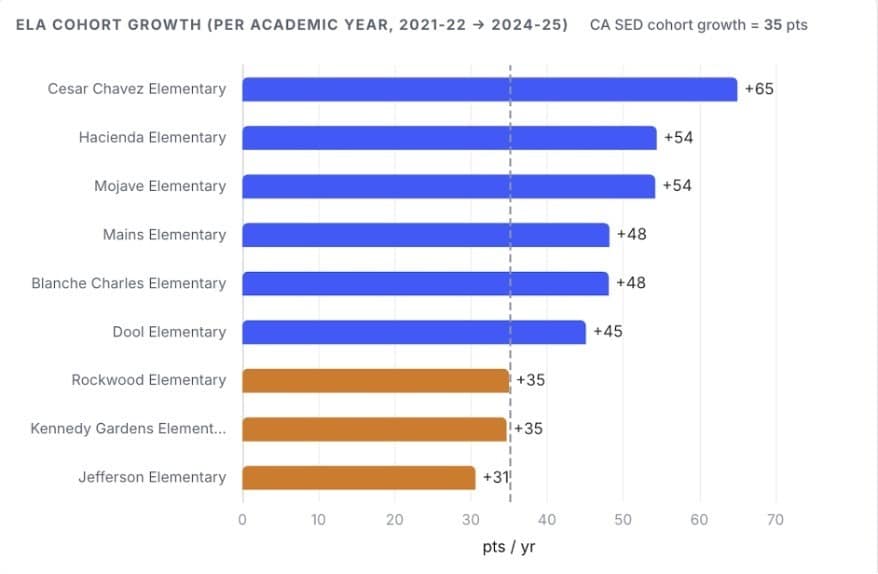
Accelerated achievement data occurs when taught standards and tested rigor overlap – and our latest round of impact data demonstrates the power of Orenda’s Curriculum Alignment design. Our Executive Team’s most recent analysis of our impact data confirmed a continuing trend: our Curriculum Alignment process, when implemented with fidelity, produces steep achievement gains for traditionally underperforming student groups. Recent impact data highlights include our cohort of elementary schools that engaged in ELA Curriculum Alignment processes over five specific academic years: 2020-21 through 2024-25. As a 35 scale score point growth on the Smarter Balanced Assessment generally equates to a full year of academic growth (https://caaspp-elpac.ets.org/caaspp/ScaleScoreRangesSB), it is truly remarkable to see the following results: students classified as “SED” (Socio-Economically Disadvantaged) at eight of nine schools met the annual growth target of 35 scale score points, and six of nine schools are substantially outpacing their annual growth target. In schools outpacing the 35-point growth target, students are demonstrating the equivalent of 1.5 to nearly 2 years of literacy growth within a single academic year. 

Why This Works

These remarkable results are a direct outcome of faithful implementation of Orenda’s Curriculum Alignment (CA) design, which expands upon our field’s general understanding of curriculum alignment as outlined in a 2018 article by the Center on Standards and Assessment Implementation (WestEd-CRESST collaboration), titled “Standards Alignment to Curriculum and Assessment” (https://files.eric.ed.gov/fulltext/ED588503.pdf). This oft-cited article from 2018 defines alignment as “the process of ensuring that the specified curriculum is consistent with enabling students to reach the milestones outlined in the standards. A curriculum that is aligned to standards is a curriculum that ensures that students have the opportunity to access the content and skills outlined in those standards.” (CSAI, 2018) Orenda’s Curriculum Alignment process produces results superior to other efforts because it includes one crucial extra step: it aligns the teaching and learning of state standards (the “curriculum”) with the rigor demanded by California’s major assessment of learning in English and math, the California Assessment of Student Performance and Progress (CAASPP). 

A Standard in Practice

This distinction is crucial. Other methods of backwards design, long established as a fundamental step in developing units of instruction, begin only with the state standards. This can result in students experiencing different levels of rigor in the same grade level. The California Common Core State Standards (CCCSS) are instructional goals; the CAASPP Item Specifications provide a testable definition of rigor. Consider, for example, the 6th grade English Language Arts (ELA) standard RL.1: Cite textual evidence to support analysis of what the text says explicitly as well as inferences drawn from the text. This standard is assessed under multiple Claims and Targets, but it is primarily assessed under Claim 1, Target 1. Examination of the information contained in the Item Specifications yields the following detailed guidance for teachers: 

  1. It assigns a concrete cognitive demand level. The standard alone gives no signal on depth; Target 1 pins it to R-DOK2, describing this as work that includes the engagement of some mental processing beyond recalling or reproducing a response; it requires both comprehension and subsequent processing of text, specifically noting that intersentence analysis of inference is required. That’s a rigor ceiling and floor teachers can plan against.
  2. It specifies text type constraints that affect complexity. Item Specification guidance states that stimuli are texts of literary fiction that will include sufficient detail, both stated and implied, to allow for the formation of inferences or conclusions — meaning practice passages need to be built for inference support, not just any fiction excerpt.
  3. It shows the exact question format students will face. The appropriate stems, e.g. “Which detail/sentence/line from the text indicates/best supports [provide inference or conclusion based on the text]?“, let teachers reverse-engineer classroom questioning and common formative assessment design so students practice the actual cognitive move, not just a generic “find evidence” prompt.
  4. It defines the response format, which shapes instructional practice. Allowable item types include Multiple Choice, single correct response; Multi-Select, multiple correct response; Hot Text, select text — all selection-based, not constructed-response. That’s a useful point of contrast if your teacher teams assume that evidence citation is always short-answer or essay-based.

The precision produced by aligning around the Item Specifications, as opposed to generic planning around the language of the standard, is part of the secret sauce that yields accelerated results for Orenda partners.

When the Alignment phase concludes, the next phase of work – implementation of the “Golden Ticket” instructional model across the district – provides support to teachers in developing powerful teaching and learning practices in their classrooms. This next step in the alignment process empowers teachers with research and strategies to effectively scaffold student learning so that all students can achieve grade-level proficiency – as defined by both the standards and Smarter Balanced/CAASPP Item Specifications.

This bundle allows you to attend ALL 3 of our GA sessions:

(for more details, please click the links to each of the session pages)

Tues, Sept. 17 – GA 101 – Intro To Guidance Alignment

Wed, Sept. 18 – GA 102  Relative Advantage and Counseling Team Planning

Thurs, Sept. 19 – GA 201  How To Lead A GA Session

Guidance Alignment (GA)

Guidance Alignment 101-201 is the perfect series for secondary administrators, counseling teams, wrap-around support providers, and expanded day partners! This transformative event is designed to propel your school toward rapid improvement of its A-G completion rate and other key College/Career Indicator (CCI) metrics.

Often, professional development focuses primarily on teachers and administrators, overlooking the needs of our counseling teams. This highly interactive and fun-filled day brings teams from across the state together to address systemic barriers in their districts and discover ways to overcome the inequitable practices that hinder achievement for vulnerable student groups.

Join us for an inspiring and collaborative experience to enhance your team’s ability to support every student’s success!

PARKING DIRECTIONS

As long as there is no business name on the parking space, feel free to park. Our parking spaces are labeled as REMITA. Please note that the Credit Union Bank will tow cars, so please make sure that they do not in front or behind the bank (those spaces are labeled).

Upon entering the SELA HUB parking lot from Erickson Ave:

  1. AREA 1 (red) is to the RIGHT of the front office.

NOTE: Do Not Park in front of the Credit Union Bank

  1. AREA 2 (green) is to the LEFT of the front office.
  2. AREA 3 (blue) is located directly BEHIND the front office and around the business complex. All spaces that are blank and do not have a business name on them are available for parking.