
X Marks the Spot: What makes Orenda’s Curriculum Alignment process so powerful?

The Data
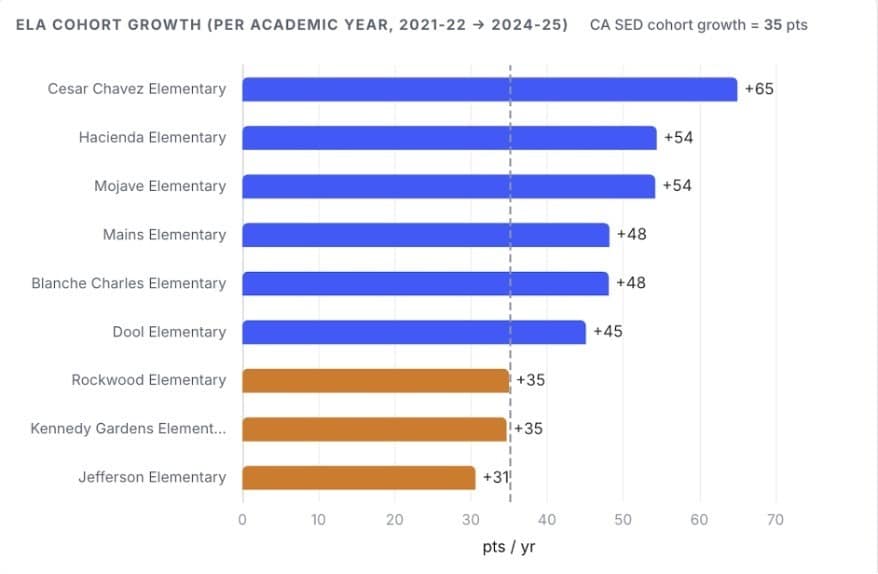
Accelerated achievement data occurs when taught standards and tested rigor overlap – and our latest round of impact data demonstrates the power of Orenda’s Curriculum Alignment design. Our Executive Team’s most recent analysis of our impact data confirmed a continuing trend: our Curriculum Alignment process, when implemented with fidelity, produces steep achievement gains for traditionally underperforming student groups. Recent impact data highlights include our cohort of elementary schools that engaged in ELA Curriculum Alignment processes over five specific academic years: 2020-21 through 2024-25. As a 35 scale score point growth on the Smarter Balanced Assessment generally equates to a full year of academic growth (https://caaspp-elpac.ets.org/caaspp/ScaleScoreRangesSB), it is truly remarkable to see the following results: students classified as “SED” (Socio-Economically Disadvantaged) at eight of nine schools met the annual growth target of 35 scale score points, and six of nine schools are substantially outpacing their annual growth target. In schools outpacing the 35-point growth target, students are demonstrating the equivalent of 1.5 to nearly 2 years of literacy growth within a single academic year.
Why This Works
These remarkable results are a direct outcome of faithful implementation of Orenda’s Curriculum Alignment (CA) design, which expands upon our field’s general understanding of curriculum alignment as outlined in a 2018 article by the Center on Standards and Assessment Implementation (WestEd-CRESST collaboration), titled “Standards Alignment to Curriculum and Assessment” (https://files.eric.ed.gov/fulltext/ED588503.pdf). This oft-cited article from 2018 defines alignment as “the process of ensuring that the specified curriculum is consistent with enabling students to reach the milestones outlined in the standards. A curriculum that is aligned to standards is a curriculum that ensures that students have the opportunity to access the content and skills outlined in those standards.” (CSAI, 2018) Orenda’s Curriculum Alignment process produces results superior to other efforts because it includes one crucial extra step: it aligns the teaching and learning of state standards (the “curriculum”) with the rigor demanded by California’s major assessment of learning in English and math, the California Assessment of Student Performance and Progress (CAASPP).
A Standard in Practice
This distinction is crucial. Other methods of backwards design, long established as a fundamental step in developing units of instruction, begin only with the state standards. This can result in students experiencing different levels of rigor in the same grade level. The California Common Core State Standards (CCCSS) are instructional goals; the CAASPP Item Specifications provide a testable definition of rigor. Consider, for example, the 6th grade English Language Arts (ELA) standard RL.1: Cite textual evidence to support analysis of what the text says explicitly as well as inferences drawn from the text. This standard is assessed under multiple Claims and Targets, but it is primarily assessed under Claim 1, Target 1. Examination of the information contained in the Item Specifications yields the following detailed guidance for teachers:
- It assigns a concrete cognitive demand level. The standard alone gives no signal on depth; Target 1 pins it to R-DOK2, describing this as work that includes the engagement of some mental processing beyond recalling or reproducing a response; it requires both comprehension and subsequent processing of text, specifically noting that intersentence analysis of inference is required. That’s a rigor ceiling and floor teachers can plan against.
- It specifies text type constraints that affect complexity. Item Specification guidance states that stimuli are texts of literary fiction that will include sufficient detail, both stated and implied, to allow for the formation of inferences or conclusions — meaning practice passages need to be built for inference support, not just any fiction excerpt.
- It shows the exact question format students will face. The appropriate stems, e.g. “Which detail/sentence/line from the text indicates/best supports [provide inference or conclusion based on the text]?“, let teachers reverse-engineer classroom questioning and common formative assessment design so students practice the actual cognitive move, not just a generic “find evidence” prompt.
- It defines the response format, which shapes instructional practice. Allowable item types include Multiple Choice, single correct response; Multi-Select, multiple correct response; Hot Text, select text — all selection-based, not constructed-response. That’s a useful point of contrast if your teacher teams assume that evidence citation is always short-answer or essay-based.
The precision produced by aligning around the Item Specifications, as opposed to generic planning around the language of the standard, is part of the secret sauce that yields accelerated results for Orenda partners.
When the Alignment phase concludes, the next phase of work – implementation of the “Golden Ticket” instructional model across the district – provides support to teachers in developing powerful teaching and learning practices in their classrooms. This next step in the alignment process empowers teachers with research and strategies to effectively scaffold student learning so that all students can achieve grade-level proficiency – as defined by both the standards and Smarter Balanced/CAASPP Item Specifications.